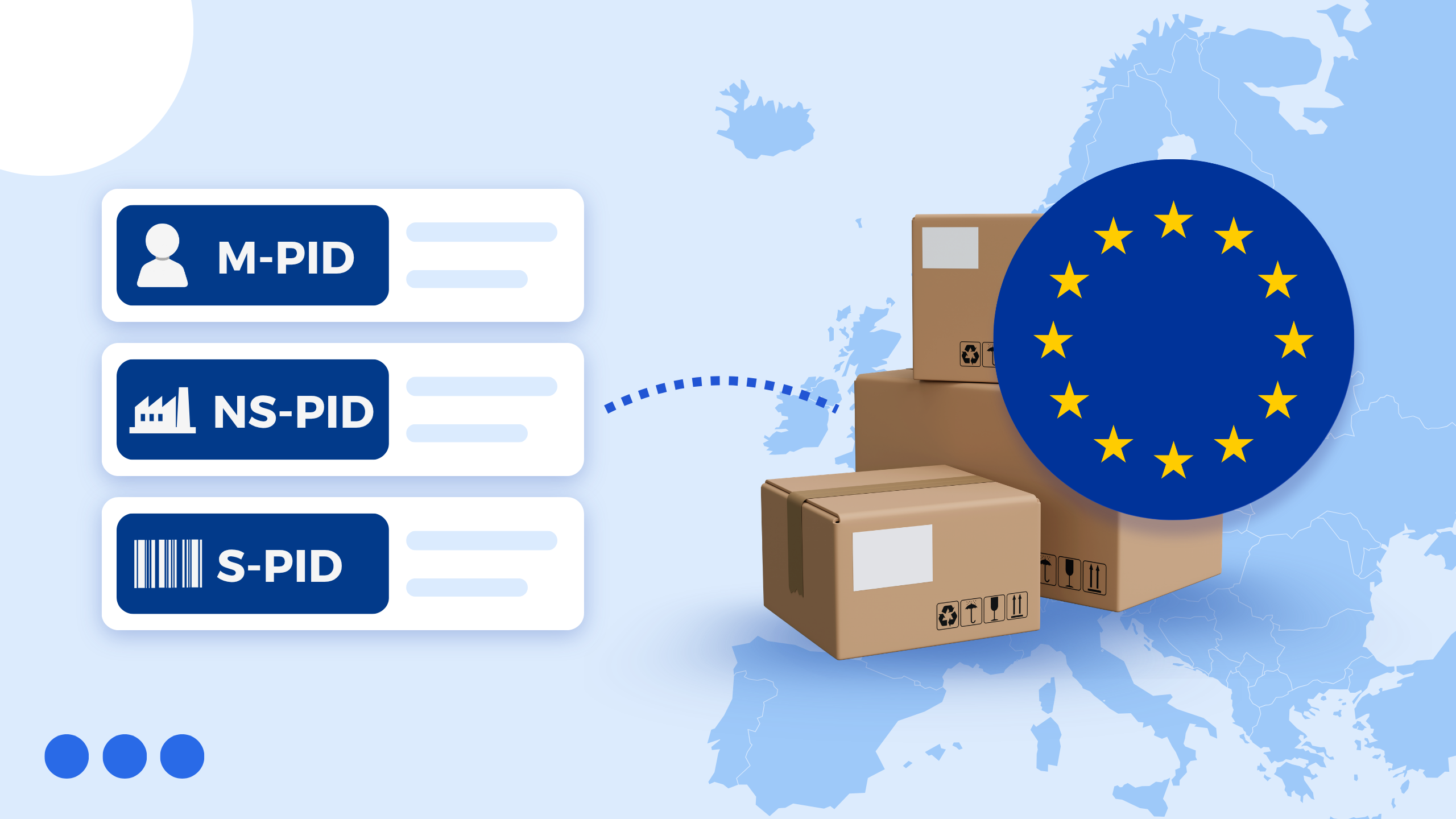
From 1 November 2026, the EU requires product identifiers on the customs declaration for online orders that sellers outside the EU ship to consumers in the EU. The EU calls them M-PID, NS-PID and S-PID. So if you sell into Europe from the US, the UK or anywhere else outside the Union, this affects your consumer orders into the EU, at least those in consignments worth up to €150.
The rule itself is short. In practice, however, getting the right codes for a few thousand products takes time. Below, you will find what the requirement says and how to find the identifiers you are missing.
Last updated: 21 October 2026. The scope of the rule may change once the EU adopts a pending amendment to the legal text. We will update this article after updates on November 1st 2026.
What is the EU product identifier requirement?
It is an EU customs rule, and it applies to sellers anywhere in the world. Commission Delegated Regulation (EU) 2026/1022 added product identifiers (PIDs) to the data required for distance sales of imported goods. In plain terms, that means goods a seller ships from a non-EU country to a private customer in the EU. The requirement therefore applies mainly to sales to consumers (B2C). According to the Commission, business-to-business imports “in principle” fall outside its scope.
Declarants report the identifiers on the import declaration, per goods item (declaration line) and for each product variant in it. You do not have to print anything on the product or its packaging. Since 1 July 2026, operators have been able to provide the identifiers voluntarily, and no sanctions could be imposed during that period. However, according to the European Commission’s guidance, enforcement starts on 1 November 2026. The guidance also mentions declarations being “held or rejected for non-compliance with the PID requirement” (section 8.8). In addition, it treats incomplete or inaccurate identifier data as an infringement under Article 274(1)(b) of the new Union Customs Code (section 8.4).
The reason behind it is product safety. EU-wide customs checks found that a high share of low-value goods sent directly to consumers did not meet EU product rules. With an identifier on every declaration line, customs can take one failed check and find every other shipment of the same product.
Which shipments are covered?
The Commission’s updated guidance (version of 5 October 2026, published on 7 October) limits the requirement to distance sales in consignments with an intrinsic value of up to €150. That is the same scope as the temporary €3 customs duty per item (tariff line). The Commission says it is amending Annex B of Delegated Regulation (EU) 2015/2446 to put this limit into the legal text.
Until the EU adopts that amendment, however, the legal text itself does not contain the €150 limit. Annex B, as quoted in section 8.2 of the same guidance, requires identifiers “for each item regarding goods sold in distance sales of imported goods” and mentions no value. In addition, the guidance itself is explanatory and not legally binding. So confirm the scope for your shipments with your declarant.
Either way, it makes sense to collect identifiers for your whole catalog. The Commission calls PIDs a first step, with broader product data requirements to follow once the EU Customs Data Hub for e-commerce is in place from July 2028.
Also, do not mix this up with the separate €2 Union handling fee, which is due to start on 1 November 2026 as well. According to the Commission’s guidance, the fee applies per item (declaration line) to distance sales of imported goods regardless of value, including consignments above €150. Its scope is therefore wider than the one the guidance gives for product identifiers.
M-PID, NS-PID and S-PID explained
Each goods item on the declaration needs up to three identifiers for each product variant in it, and each one comes from a different party.
| Identifier | Full name | Who assigns it | What it usually is | Required? |
| M-PID | Merchant product identifier | The online seller, marketplace or platform | On your own webshop: your SKU or listing ID. On a marketplace: the marketplace’s identifier for the product, not your own SKU | Always |
| NS-PID | Non-standardised manufacturer product identifier | The manufacturer, producer or product supplier | Manufacturer part number (MPN), model or article code | Always |
| S-PID | Standardised manufacturer product identifier | The manufacturer, producer or product supplier, following an international standard | GTIN (EAN or UPC), ISBN for books | Where one exists |
Where the identifiers go on the declaration
Declarants report them on the import declarations for these sales (H1, H6 or H7) whenever the declaration carries one of the e-commerce codes F48 (IOSS), F49 (special arrangements) or F53 (standard procedure). The identifiers go in as supporting-document codes C127 (M-PID), C128 (NS-PID) and C129 (S-PID). If no standardised identifier exists, the declaration instead carries the code Y081, in a separate field.
The rules that matter in practice
- On a marketplace, the M-PID is the platform’s. The guidance says the M-PID is “determined by and used on the platform, not the individual sellers”. It should also be unique on each platform, however many sellers offer the product (section 8.4). In other words, if you sell through a marketplace, the M-PID is the marketplace’s identifier for that product. Your own SKU is the M-PID only on your own webshop.
- Variant level, for the whole lifecycle. Each identifier has to point to one product variant and stay the same throughout the product’s life. For example, a blue shirt in medium needs a different code than the red one. Reporting batch or unit codes where a model-level code exists counts as an infringement (section 8.4).
- An MPN is an NS-PID. Some guides list the MPN as a standardised identifier. However, the manufacturer assigns it without an international standard behind it, so it belongs in the NS-PID field.
- Having no GTIN is fine, an empty field is not. If a product has no standardised identifier, the declaration carries the exception code Y081 instead. Y081 means no standardised identifier exists. It does not mean you could not find one. Also, nobody has to obtain a GTIN just for this rule.
Exceptions and special cases
- Bundles. For a bundle on one declaration line, such as a laptop with a sleeve and a mouse, the declaration carries Y081 only if none of the bundled products has an S-PID (section 8.7).
- There is no exception code for the NS-PID. If none exists, the Commission expects the manufacturer to assign one.
- One code, two fields. A manufacturer may use the S-PID as its NS-PID, and a platform may use it as its M-PID. Even then, both document codes should still be declared, with the same value in each (section 8.7).
- Tolerances for certain goods (section 8.8). For goods under certain commodity codes, customs accepts the placeholder text “M-PID” in C127 and “NS-PID” in C128. The guidance lists unprocessed agricultural and perishable goods (Chapters 1 to 15), specific codes for handmade and artisanal goods, and headings 9701 to 9706 for art, antiques and collectibles. It also calls this list non-exhaustive.
- Medical devices and medicines (section 8.8). For medical devices, the UDI-DI counts as the S-PID. For medicines, the product code (AI 01) may serve as the S-PID.
- Second-hand and personalised goods (section 8.8). These get no tolerance. Instead, they use the identifiers of the original or underlying product.
Who is responsible for what?
The guidance splits the work between three groups. First, sellers, marketplaces and platforms assign the M-PID. Second, manufacturers and suppliers assign the NS-PID and the S-PID, and the guidance expects them to pass these down the supply chain. Finally, the declarant, often the IOSS holder, a carrier or a customs broker, submits them.
As a seller, you usually do not send the identifiers to customs yourself. Instead, you pass them electronically with the shipment data to whoever lodges the declaration: the carrier, postal operator, broker or IOSS intermediary. Under Article 15 of the Union Customs Code, the person who lodges the declaration is responsible for its accuracy. The exception: if you use your own IOSS number, you are first in line as declarant, either in your own name or, for sellers outside the EU, through an indirect representative.
If you resell other brands’ products, you sit in the middle. In that case, you do not create the manufacturer identifiers, but your carrier or broker will still ask you for them.
The hard part is the product data
The M-PID is usually within reach: your own SKU on your webshop, or the identifier the marketplace uses. The manufacturer codes, on the other hand, are less tidy. For example, the MPN might sit in a supplier price list, the EAN in a different feed, and for part of the catalog one of the two is missing or wrong.
For twenty products, you can fix that by hand. For twenty thousand, however, you need a reference that knows which MPN belongs to which GTIN.
Find the missing identifier with Icecat
Icecat builds its catalog on exactly that pairing. It identifies every product data-sheet by brand plus manufacturer product code, and most data-sheets also carry one or more GTINs. As a result, you can start from whichever identifier you have:
- You have the GTIN: look up the brand and manufacturer product code. That is your NS-PID.
- You have brand and MPN: look up the GTIN. That is your S-PID.
You can do this per product through the Icecat integrations, or for a whole catalog at once. With the free coverage analysis, you upload a feed with brand, product code, GTIN and your own internal ID. Matched products list your ID, the manufacturer code and the GTIN side by side, which on your own webshop covers the M-PID, NS-PID and S-PID in one row.
Coverage is strongest for branded goods in categories such as consumer electronics, IT, home appliances and toys. Products that do not match show you where to ask your supplier for the missing code, including whether a GTIN exists for the product at all. And because every match is a full data-sheet, you get specifications, images and descriptions for your listings along with the identifier.
Keep identifiers flowing with Icecat Commerce
Finding the codes once is a cleanup. However, new products arrive every week, and the rule applies to them as well. This is where Icecat Commerce comes in.
Icecat PIM keeps SKU, brand, MPN and GTIN together on each product record. Supplier and distributor feeds come in through Icecat Connect in one standardised format, and Icecat PIM then enriches the products with Icecat content based on MPN and brand. In addition, import filters can check whether a product’s EAN is complete before it reaches your catalog.
From there, connectors send the product data to e.g. Shopify, Magento, WooCommerce, Odoo or Amazon. Or you connect them yourself to your internal tools and webshop via files and API. As a result, the identifiers arrive in your shop with the product, so they are available when your shipping tool or broker builds the declaration.
To be clear about the limits: Icecat does not file customs declarations, and responsibility for the declaration stays with the declarant. What we can do is make sure the right identifiers are in your systems when someone asks for them.
What to do before 1 November
- Export the products you ship to EU consumers with SKU, brand, MPN and GTIN.
- Run the list against Icecat to fill the gaps and catch mismatches.
- Ask your suppliers for what is still missing, and mark products that have no GTIN at all.
- Store all three identifiers per variant in one place and map them to your shop and shipping fields.
- Ask your carrier or broker how they want to receive them.
There is one more reason to do this properly. The Commission describes the identifiers as a first step, with more product data requirements to follow when the EU Customs Data Hub opens for e-commerce in July 2028.
Want to know how many of your products already have a matching MPN and GTIN?
Contact our team and we will look at your catalog with you.
This article summarises the rules for information purposes. It is not customs or legal advice. The European Commission documents linked above are the reference.
What does NS-PID stand for?
Non-standardised manufacturer product identifier. It is the product code that a manufacturer, producer or supplier assigns on its own, without relying on an international standard. For most branded products that is the MPN.
Is the MPN an NS-PID or an S-PID?
An NS-PID. Only codes based on international standards, such as a GTIN (EAN, UPC) or an ISBN, count as an S-PID.
Is a GTIN mandatory for shipping to the EU?
No. You only need the S-PID where one exists. If a product has none, the declaration carries the exception code Y081, which means no standardised identifier exists. Nobody has to obtain a GTIN just for this rule. However, you always need the M-PID and NS-PID.
Is this a US regulation?
No. It is EU customs law. However, it applies to any seller outside the EU who ships to consumers in the EU, including sellers in the US and the UK.
Does it only apply to parcels up to €150?
According to the European Commission’s updated guidance (version of 5 October 2026, published on 7 October), yes: it covers distance sales in consignments with an intrinsic value of up to €150. The Commission is still amending the legal text to match, and until then the law itself sets no €150 limit. Confirm the scope for your shipments with your declarant.
Do you have to print the identifiers on the product?
No. They are data on the customs declaration, and the declarant provides them per declaration line for each product variant.
How can I find a GTIN from an MPN?
With the brand name and MPN, you can look up the product in Icecat and read the GTIN from its data-sheet. In addition, you can match a whole product feed at once. It also works the other way round, from GTIN to brand and MPN.

Elisabeth is part of the MarCom team at Icecat Commerce, where she combines technical product knowledge with real-world client situations. Having worked directly with clients on their product data challenges, she writes from the perspective of what actually matters in day-to-day e-commerce operations.